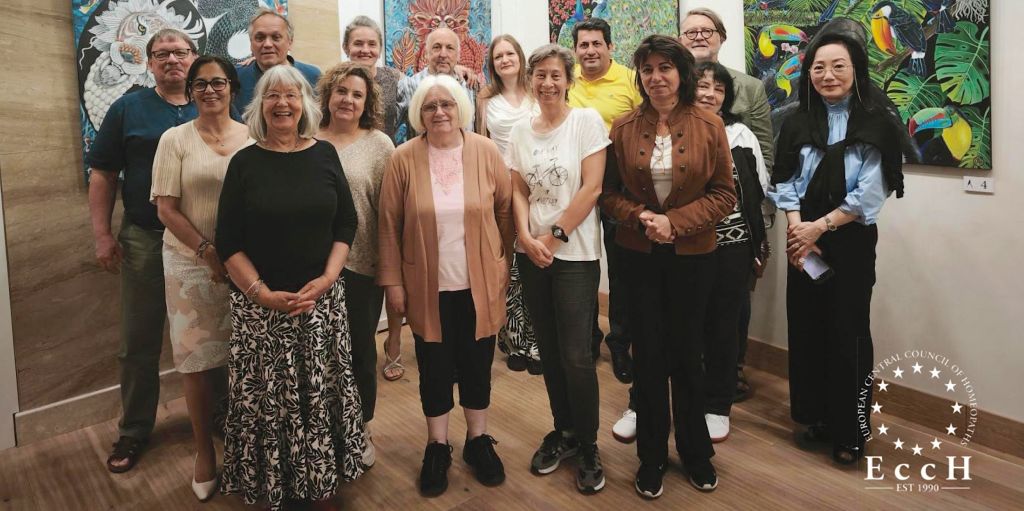
From 14 to 17th May, this year’s Annual General Meetings of the International Council for Homeopathy (ICH) and the European Central Council of Homeopaths (ECCH) took place in Sofia, Bulgaria. The meeting was organised by our Bulgarian colleagues, who provided a very welcoming atmosphere with a centrally located venue and warm hospitality. The sessions were held in a hybrid format, enabling representatives who were unable to travel to participate online.
The meetings brought together delegates from many parts of Europe as well as other regions of the world, including representatives from North America, Africa, New Zealand, Japan and Hong Kong.
Many participants felt that the atmosphere throughout the meetings was exceptionally open, committed and constructive.
In addition to the official sessions, shared meals, informal conversations and social encounters provided valuable opportunities for personal exchange and networking. Many participants particularly appreciated these direct encounters, as numerous representatives had previously only known each other through online meetings.
A central theme running through this year’s assemblies was the recognition that international cooperation and stronger public visibility are becoming increasingly important for the future of homeopathy. Or, as was repeatedly expressed in various ways: “Together we are stronger.”
14–15th May 2026 – ICH
Within the framework of the International Council for Homeopathy (ICH), several current developments and projects were presented that are of major importance for the future positioning of homeopathy worldwide.
One current focus is the use of digital tools in homeopathic research and documentation. The AI-supported tool “Case Scribe” is now operational and is currently being tested by a working group. Its aim is to transform case reports more efficiently into structured articles suitable for scientific journals.
Another proposal by the ICH Chair concerns the creation of a category of “ICH-recognised homeopaths.” This could help strengthen the international credibility of the profession. However, since the legal and professional status of homeopathy varies considerably between countries, the proposal remains under discussion.
ICH is also involved in the quarterly meetings of the international TCIH coalition, so to be informed about work in progress and upcoming events.
To support international advocacy work, ICH has prepared an official position statement that member organisations can use for political advocacy and public communication.
Country-specific developments were also discussed. In the United States, homeopathic remedies are not officially approved drugs according to the FDA since the new (2019) Guidance document was approved. Historically labelling of homeopathic remedies was established that even though they are sold over the counter as unapproved drugs they must list a general indication for use. With no legal recognition of homeopathic drugs, at any point in time the FDA can pull specific products from the market. The American Institute of Homeopathy is currently in discussions with the U.S. Food and Drug Administration (FDA) regarding these regulatory issues, and the consumer group Americans for Homeopathy Choice has submitted legislation to congress to ensure continued access to all Homeopathic remedies. It may take several years for this legislation to be enacted. In the meantime, legislation has been approved that has cut funding to the FDA with regards to policing the published 2019 Guidance, so even though it stands the OTC products are available over the counter as unapproved drugs, generally speaking nothing is being done about removing single remedies from the shelf.
Finally, it was reported that colleagues from Hong Kong will represent homeopathy at the upcoming WHO Congress in Beijing in order to further strengthen the international visibility of homeopathy.
15th May 2026 – Joint Meeting of ICH and ECCH
As part of this year’s General Assemblies, a joint meeting between ICH and ECCH took place, focusing on current international developments, research projects, as well as political and strategic issues concerning homeopathy. A strong commitment to international cooperation and closer networking between organisations working in the field of traditional, complementary and integrative medicine (TCIM) was clearly evident throughout the meeting.
One important focus was the work of the European Federation of Homeopathic Patients’ Associations (EFHPA). Miranda Ruchtie, ECCH Policy Officer and Co-President of EFHPA, summarized the importance of patient representation: patients are considered the strongest ambassadors for homeopathy. Their experiences and feedback can generate public attention and influence political discussions, often more effectively than professional arguments alone.
Alongside scientific research, “Patient Reported Outcomes” (PROMs) and real-world patient experiences are therefore becoming increasingly important. The aim is to involve patients more actively, strengthen their visibility.
In this context, the international “HOMA” research project was also presented. More than ten systematic reviews are planned to evaluate the efficacy, effectiveness and safety of homeopathic medicinal products for various conditions. Particularly noteworthy is that patients are to be actively involved in the research process for the first time. The goal is to produce scientifically robust yet patient-centred results. Patient Advisors are currently being recruited, including for the field of wound healing.
Miranda Ruchtie also reported on participation in the AYUSH Conference in Dubai, where representatives of several homeopathic organisations gave presentation on homeopathy’s role in healthcare.
A definite highlight was the presentation by Dr. Dora Pachova, who spoke about her international work representing homeopathy in international congresses.
Overall, the joint meeting clearly demonstrated how important international networking, joint political strategies, research activities and collaboration with patient organisations have become for the future development of homeopathy.